CoursesSystem design from first principles to design review
Puzzle 7 · 8 of 19
How do you send an event after a crash?
Save the business change and the work it creates together.
All puzzles in this course
The problem
The reservation commits, then the process dies before sending a notification. Sending first could instead announce a reservation that later rolls back. Where should the obligation to send live? Here, an event is the message “grant 301 was created.” A sender publishes that message. A consumer receives it and updates its own data.
See it
Scroll sideways to see the full diagram.
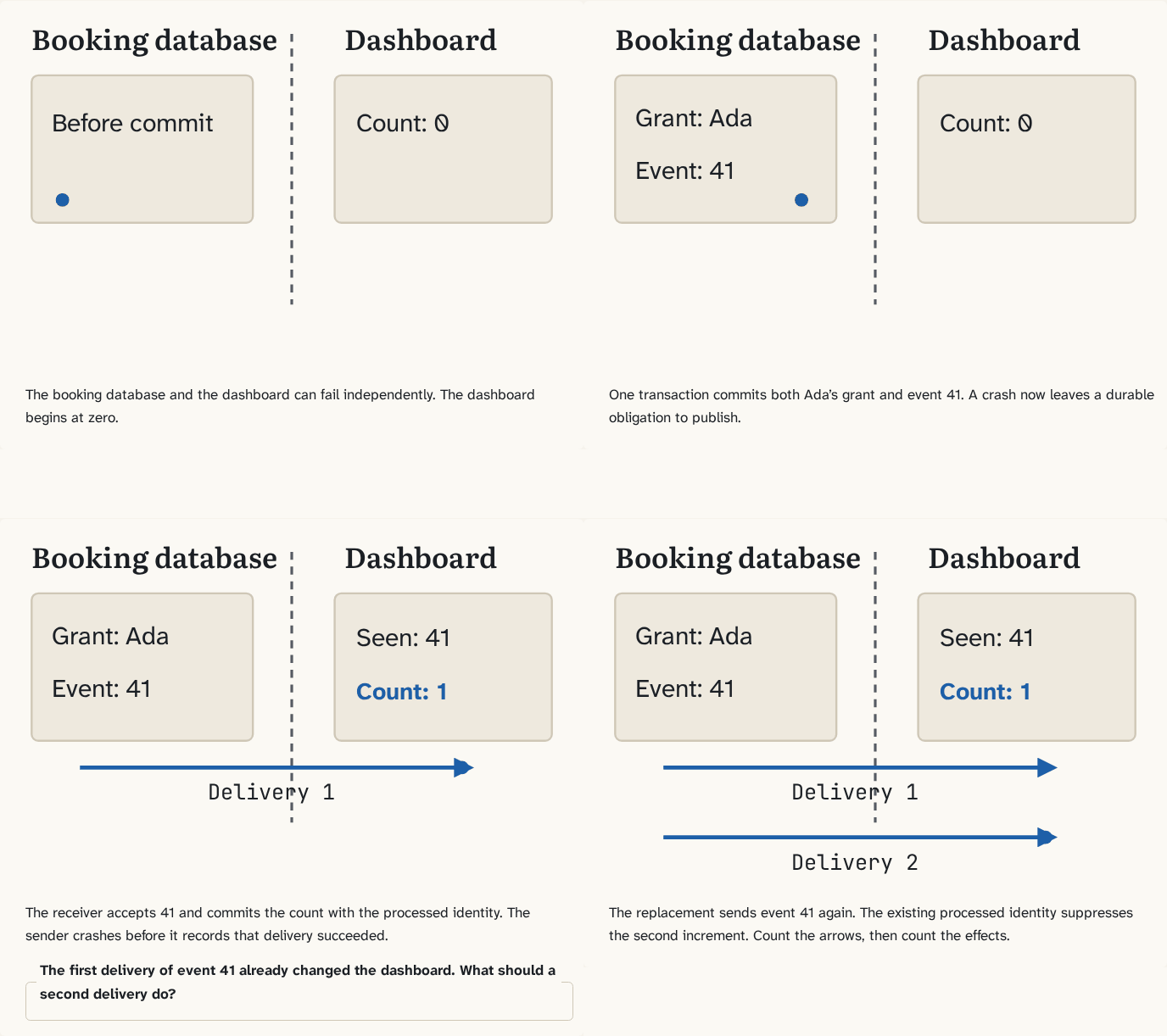
The booking database and the dashboard can fail independently. The dashboard begins at zero.
Step 1 of 4One transaction commits both Ada’s grant and event 41. A crash now leaves a durable obligation to publish.
Step 2 of 4The receiver accepts 41 and commits the count with the processed identity. The sender crashes before it records that delivery succeeded.
Step 3 of 4The replacement sends event 41 again. The existing processed identity suppresses the second increment. Count the arrows, then count the effects.
Step 4 of 4
The building block
Store an event, a record saying that something happened, such as a space being granted, in the same transaction as the reservation. This is the transactional outbox pattern. Another process reads committed events and delivers them. After a restart, the service can distinguish pending work from a reservation that never happened.
A sender can deliver an event and crash before marking it complete. After recovery it can deliver again. A consumer can store the event identity and its own database effect in one transaction. That protects the database effect from repetition. An email provider forms another boundary. A local transaction alone cannot guarantee exactly one message in the driver's inbox.
Follow event 41 through a crash
Ada's committed reservation and event 41 appear together. A worker publishes 41 and stops before recording the delivery. A replacement publishes 41 again. On the receiving side, insert 41 into a table of processed identities and update the local reservation view in one transaction. The first delivery commits both changes. A duplicate detects the existing identity and leaves the view alone.
Reverse the receiving order and commit the processed marker on its own first. A crash before the view update now loses the effect permanently: every retry finds a completed marker. To test the repaired version, stop the worker at each boundary, run the worker again, and count both distinct processed IDs and visible reservations.
Go deeperWhat if events arrive out of order?
Grant has version one and a later reversal version two. Applying two and then one blindly can resurrect a cancelled grant. Event identity detects a duplicate, but cannot order two different events. For complete state snapshots a consumer can retain the highest applied version per object. For incremental changes, a gap may require replay or rebuilding from an authoritative snapshot.
May a balance consumer skip a missing event that only contains an amount to add?
Not without another recovery rule. The missing amount changes the total.
First puzzle: What survives at the sender?
Put your finger on the last instruction that reached the database. A stopped process loses its next line of code. On restart, a separate worker can see the rows that committed. What evidence would let it discover that grant 301 needs to be announced?
Here are two writes that belong to the sender. Grant 301 reserves the space. Event 41 gives the worker a durable obligation to announce that grant. The two counts show what a fresh worker would find. The first result shows the state before the attempt. Predict the second result before running the code.
CREATE TABLE grant_record (id INTEGER PRIMARY KEY);
CREATE TABLE outbox (
  event_id INTEGER PRIMARY KEY,
  grant_id INTEGER NOT NULL REFERENCES grant_record(id)
);
CREATE TEMP VIEW evidence AS
  SELECT (SELECT COUNT(*) FROM grant_record) AS grants,
         (SELECT COUNT(*) FROM outbox) AS events_to_send;

SELECT * FROM evidence;
BEGIN;
INSERT INTO grant_record VALUES (301);
INSERT INTO outbox VALUES (41, 301);
ROLLBACK;
SELECT * FROM evidence;- Stop before commit. The rollback models the loss of the uncommitted transaction. You should read (0, 0) twice. No reservation survived and the worker owes no announcement.
- Stop after commit. Change the rollback line to a commit and rerun. The last result becomes (1, 1). Even if the sender stops here, the worker can recover event 41.
- Reproduce the missing event. Move the commit just above the line that inserts event 41. Delete the event insertion to model the process stopping immediately after its first commit. Predict the last pair, then run. The worker sees (1, 0). The grant exists, but an outbox reader has nothing to send.
Restore the original SQL when finished. The first decision was where to store the obligation. The next decision belongs to another service. Once the worker has found event 41, what if it sends it twice?
Second puzzle: Deliver event 41 twice to a real table
Focus on the receiving service. The publisher can deliver the same event again after a crash. This consumer owns both a table of accepted event IDs and a local count. A trigger is work the database runs as part of a statement. Here it updates the count only when a new ID is inserted.
CREATE TABLE accepted (event_id INTEGER PRIMARY KEY);
CREATE TABLE dashboard (confirmed INTEGER NOT NULL);
INSERT INTO dashboard VALUES (0);
CREATE TRIGGER count_new_grant AFTER INSERT ON accepted
BEGIN
  UPDATE dashboard SET confirmed = confirmed + 1;
END;

BEGIN;
INSERT INTO accepted VALUES (41);
ROLLBACK;
SELECT confirmed AS after_crash FROM dashboard;

INSERT INTO accepted VALUES (41)
ON CONFLICT (event_id) DO NOTHING;
INSERT INTO accepted VALUES (41)
ON CONFLICT (event_id) DO NOTHING;
SELECT confirmed, (SELECT COUNT(*) FROM accepted) AS distinct_events
FROM dashboard;The rollback removes both writes. The next delivery inserts 41 and increments the count. The last delivery inserts nothing, so the trigger never fires. The results are zero after the rollback and one confirmation for one distinct event after replay. Change only the final 41 to 42 and predict both counts.
The publishing side has a different transaction. It inserts the reservation and a row in its outbox, then commits both. A worker may publish that row more than once. The receiving transaction above protects one database projection. An email sent from outside that database would need its own delivery contract.
Try it
Crash the receipt worker and replay event 41 in the browser lab
Trace crashes before the reservation commits, after it commits, and after delivery but before acknowledgement. For each, count durable grants, pending events and possible deliveries. Give a permanently invalid event a bounded retry policy, an inspection queue and a way to replay it after repair.
Check yourself
Sources
- AWS · Transactional outbox — “The events processing service might send out duplicate messages or events”
- SQLite · CREATE TRIGGER
What you now know
Commit the event with the grant, then make repeated deliveries safe for each consumer effect.
Answer every question above correctly to unlock the next puzzle.
A retry can be safe for the data. What happens when retries still consume scarce processing capacity?
Something wrong or unclear on this page? Tell me: a puzzle that didn't click is a bug in the puzzle.