CoursesTCP to HTTPS, one request under a microscope
Puzzle 4 · 5 of 5
Can a lost image slow a text response?
Two responses share a connection. Change the transport and predict which response can keep moving after loss.
All puzzles in this course
The problem
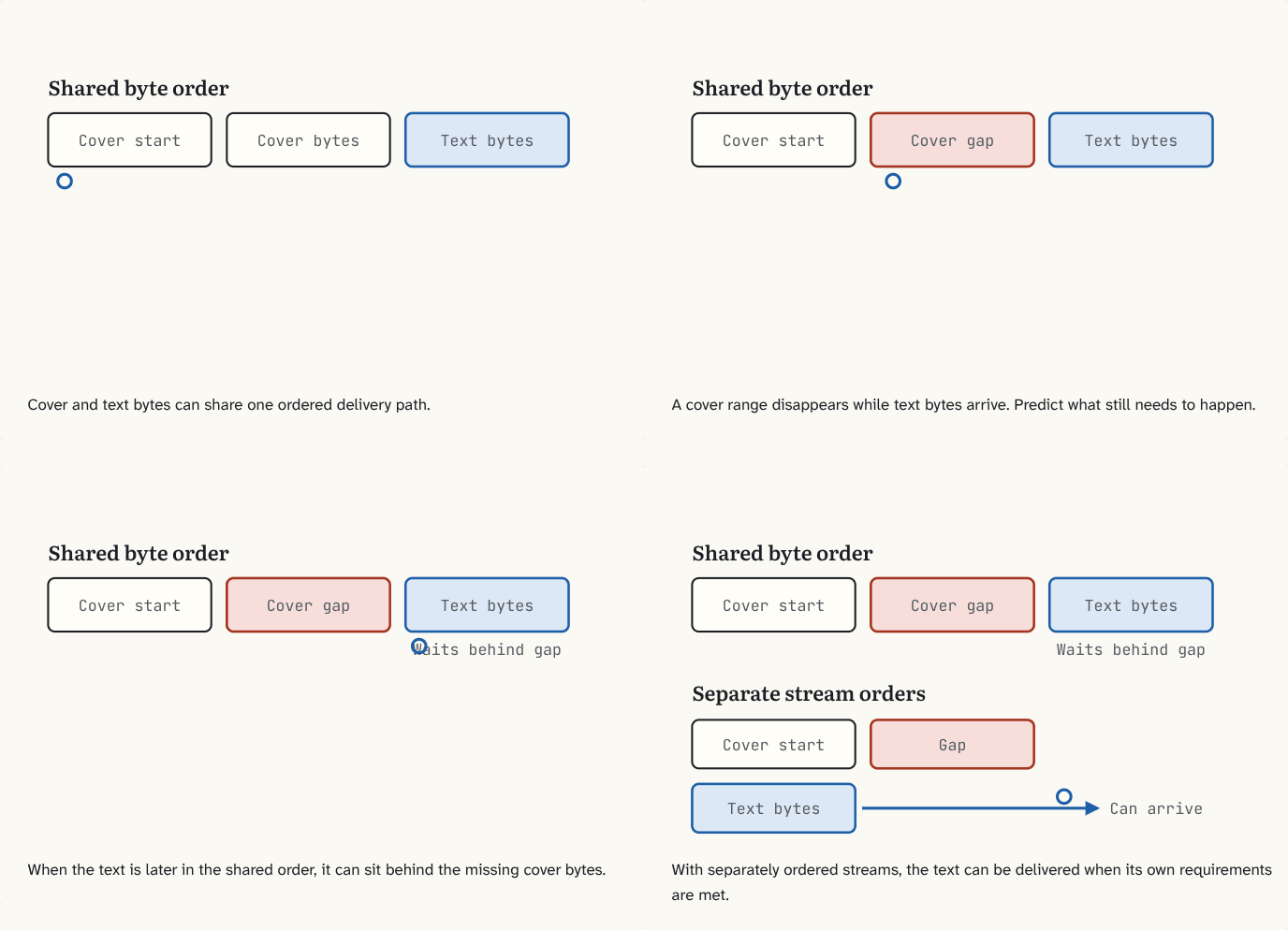
The reading app requests a large cover and a small text card together. Part of the cover response is lost, but the bytes for the text card arrive. Can the card still be shown?
See it
Scroll sideways to see the full diagram.
Cover and text bytes can share one ordered delivery path.
Step 1 of 4A cover range disappears while text bytes arrive. Predict what still needs to happen.
Step 2 of 4When the text is later in the shared order, it can sit behind the missing cover bytes.
Step 3 of 4With separately ordered streams, the text can be delivered when its own requirements are met.
Step 4 of 4
The building block
Multiplexing lets multiple exchanges share a connection. Both HTTP/2 and HTTP/3 allow this, but the transport beneath them changes what happens during loss.
QUIC is a secure transport over UDP. UDP carries separate datagrams. QUIC adds its own recovery and provides independently ordered streams.
| Protocol | Where bytes have to be delivered in order | Consequence after the cover bytes are lost |
|---|---|---|
| HTTP/2 over TCP | One shared transport byte stream with a cumulative acknowledgment | Later text-card bytes can sit behind the gap if they occur after it in that stream. |
| HTTP/3 over QUIC | Within each stream | The text card can advance if its own bytes and any compression or control information it depends on are available. |
Even on QUIC, losing one packet can affect multiple streams if that packet contained their data. Congestion control also remains shared across the connection, so traffic may slow together even where delivery can progress independently.
The practical distinction is delivery waiting behind one missing range versus a shared reduction in sending rate. The first is an ordering dependency; the second is feedback about the network path.
Go deeperTrace the dependency before blaming the protocol
A lost QUIC packet carried data for both the cover and the card. Does their independent ordering ensure the card can finish immediately?
No. If the card needs bytes that were in that packet, its own stream has a gap. Stream independence helps when the other stream has what it needs.
Check yourself
Sources
What you now know
HTTP/2 streams share one ordered TCP byte stream. HTTP/3 maps traffic onto independently ordered QUIC streams, so loss on one stream need not stop delivery on another.
Answer every question above correctly to unlock the next puzzle.
That's everything published so far
You've reached the last puzzle of TCP to HTTPS, one request under a microscope.
New puzzles are announced on LinkedIn and in the learning log feed.
Something wrong or unclear on this page? Tell me: a puzzle that didn't click is a bug in the puzzle.