CoursesSystem design from first principles to design review
Puzzle 9 · 10 of 19
When does splitting the data help?
Choose a key by following the reads and writes.
All puzzles in this course
The problem
The last-space invariant must hold even if storage ownership changes. One database is busy after a concert. Most writes concern just one lot. A teammate proposes sixteen partitions. Which particular bottleneck would that remove?
See it
Scroll sideways to see the full diagram.
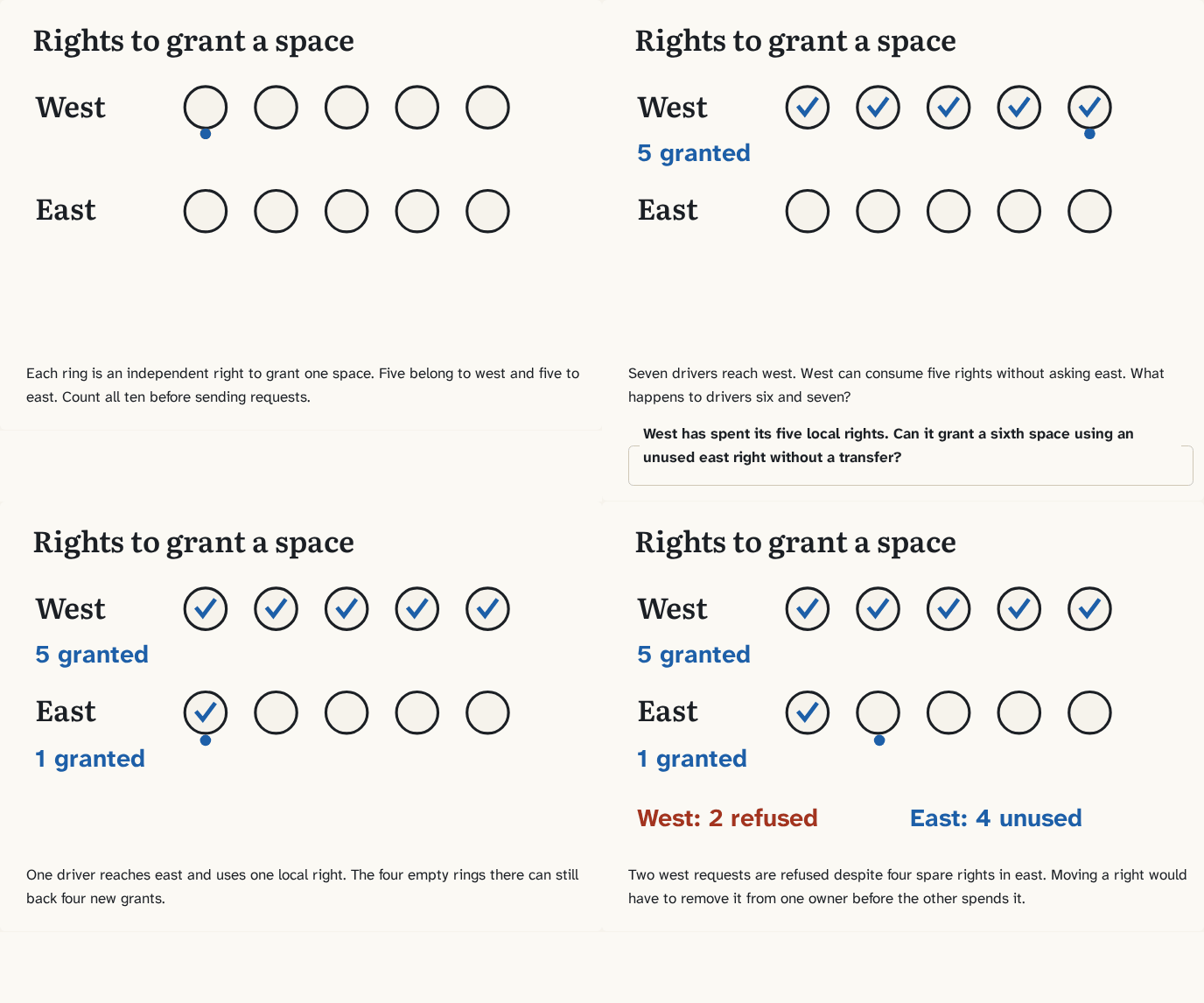
Each ring is an independent right to grant one space. Five belong to west and five to east. Count all ten before sending requests.
Step 1 of 4Seven drivers reach west. West can consume five rights without asking east. What happens to drivers six and seven?
Step 2 of 4One driver reaches east and uses one local right. The four empty rings there can still back four new grants.
Step 3 of 4Two west requests are refused despite four spare rights in east. Moving a right would have to remove it from one owner before the other spends it.
Step 4 of 4
The building block
Partitioning divides rows into pieces by a rule. A month-based split can make old history easier to remove. All pieces can still live on one machine. When pieces live in independent databases, the service must also find the owner of each key and move ownership while requests continue.
Splitting by lot keeps one reservation and its count together. A driver's history across lots may need reads from several pieces or a separate read model. If seventy percent of traffic goes to one lot, the hot key still goes to one owner. A different design allocates independent rights to regional pools. Transfers between pools must preserve the total number of rights.
Test both balance and ownership
A thousand reservation attempts arrive per second. Seven hundred go to west. With sixteen equally fast storage owners, hashing by lot still sends at least 700 attempts per second to one owner. Dividing 1,000 by sixteen gives an average of 62.5 and hides west. Measure the busiest owner's rate when deciding whether the split helped.
To transfer two unused rights from west to east, subtract two at west and record a durable transfer identity before east can spend them. East credits that identity at most once. If delivery pauses, the two rights may be temporarily unspendable. Retry the same transfer twice and reconcile available, granted and in-transit rights against the original capacity.
Go deeperHow do you move a lot while it is accepting reservations?
Moving the west lot from storage A to B takes time. Copying the current rows alone misses later writes. Record a starting position, copy the snapshot, replay subsequent changes, and compare results. At cutover, identify one active write owner and define what happens to requests sent using stale routing information. Otherwise both stores can grant the last space.
Which test is stronger than comparing row counts after the move?
Keep reserving during migration. Record every confirmed identity and verify each grant and capacity after cutover.
Add a shard without moving every key
A shard is a storage owner responsible for some keys. The service routes each reservation to the current write owner. At cutover a service instance using an old owner list must refresh it and the former owner must refuse the stale write. Try two routing functions in Python 3. The first reduces a hash, a repeatable number derived from the key, to a list position. The second scores each pair of key and owner and chooses the highest score. This second technique is called rendezvous hashing.
from hashlib import sha256

def score(text):
    return int.from_bytes(sha256(text.encode()).digest(), "big")

def modulo(key, owners):
    return owners[score(key) % len(owners)]

def rendezvous(key, owners):
    return max(owners, key=lambda owner: score(key + ":" + owner))

old = ["north", "south", "west"]
new = old + ["east"]
for route in (modulo, rendezvous):
    moves = [(route(str(k), old), route(str(k), new)) for k in range(1000)]
    changed = [(before, after) for before, after in moves if before != after]
    print(route.__name__, len(changed),
          sum(after != "east" for before, after in changed))
For these keys the output is 769 keys moved under modulo and 222 under rendezvous. Of those moves, 512 and zero respectively went between existing owners. The last column counts moves between two existing owners. Predict why it must be zero for rendezvous: adding east changes none of the old scores. If east wins, the key moves there. Otherwise the old winner stays ahead. The calculation scans every candidate and assumes agreed, stable owner names. Membership changes still require a protocol for copying state and switching the write owner.
Now route one thousand requests for the same key. Every request goes to the same winner. Reducing the number of keys you move during expansion solves a different problem from a hot lot receiving most of the traffic.
Try it
Give two pools five spaces each. Seven drivers arrive at A and one at B. Without transfers, A grants five and refuses two even though B has spare capacity. Compare that cost with waiting for a shared counter. Propose a test showing that transferring a right does not copy it.
Check yourself
Sources
- PostgreSQL · Table Partitioning — “splitting what is logically one large table into smaller physical pieces”
- Thaler and Ravishankar · Using name-based mappings to increase hit rates
What you now know
Choose the partition key for the operations that must stay together and test the hottest key.
Answer every question above correctly to unlock the next puzzle.
Local rights work without a remote vote. What if the design instead needs one shared decision during a split?
Something wrong or unclear on this page? Tell me: a puzzle that didn't click is a bug in the puzzle.