Mobile system design, from a packet to an app · Puzzle 7 · 8 of 11
Ask before you download
Your feed downloads the same 200 KB every time the screen opens, even when nothing changed. HTTP already has the answer. Here's how a response says how long it stays good, and how the app asks "has this changed?" for almost nothing.
The problem
Every time the user opens the feed, the app downloads it again: 200 KB, a round trip or more, a radio wake-up (puzzle 6). Most of the time, nothing in it has changed. How can the app avoid downloading what it already has, and still notice when it does change?
See it
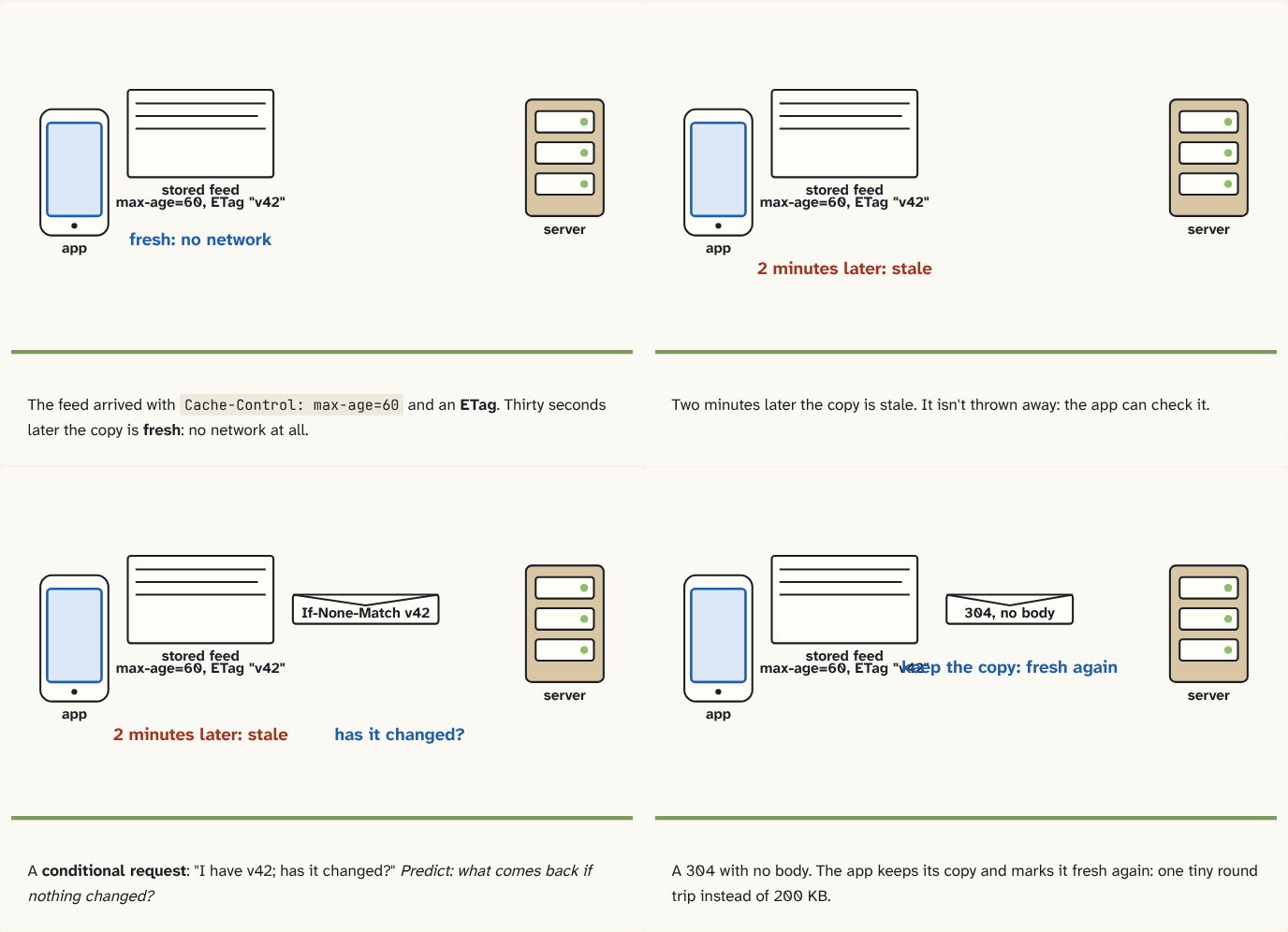
The feed arrived with
Cache-Control: max-age=60and an ETag. Thirty seconds later the copy is fresh: no network at all.Step 1 of 4Two minutes later the copy is stale. It isn't thrown away: the app can check it.
Step 2 of 4A conditional request: "I have v42; has it changed?" Predict: what comes back if nothing changed?
Step 3 of 4A 304 with no body. The app keeps its copy and marks it fresh again: one tiny round trip instead of 200 KB.
Step 4 of 4
The building block
HTTP has caching built into its responses. OkHttp implements it when you give the client a cache directory.
1. Fresh: don't ask at all. The server adds a header like Cache-Control: max-age=60. For the next 60 seconds, the stored response is fresh: the app uses it without touching the network. Zero round trips, zero radio.
2. Stale: ask, cheaply. After 60 seconds the copy is stale. It isn't thrown away. The server also sent an ETag, a short tag naming this version of the feed, like "v42". The app now sends a conditional request: "I have "v42"; has it changed?", in an If-None-Match header.
- Not changed: the server answers 304 Not Modified, with no body. The app keeps its copy and marks it fresh again. One round trip, a few hundred bytes instead of 200 KB.
- Changed: a normal
200 OKwith the new feed and a new ETag.
Two notes. Your server sets these headers, so caching is a contract with the backend team; and HTTP caching applies to GET responses. So in a system design answer, "cache it" has two levels: how long it's fresh (no network) and how it's revalidated (a cheap check). The server decides both, per response: a user's profile might be fresh for an hour; a live score, never. Two directives people mix up: no-cache means "store it, but always revalidate"; no-store means "never store it".
The analogy
A library book with a return date. Until the date, you read it without asking anyone (fresh). After, you phone the library: "is my edition still the latest?" If yes, they say "keep it" in one sentence (304), and you don't have to fetch a new copy.
Check yourself
Sources
- MDN: HTTP caching ("Stored HTTP responses have two states: fresh and stale. The fresh state usually indicates that the response is still valid and can be reused, while the stale state means that the cached response has already expired"; "If the age of the response is less than one week, the response is fresh", for max-age=604800)
- MDN: Conditional requests ("The value of the validator is used as a parameter of the If-Modified-Since and If-None-Match headers. If the resource has not changed, the server sends back a 304 Not Modified response. This makes the cache fresh again, and the client uses the cached resource.")
What you now know
Cache-Control on a response says how long it stays fresh; while fresh, the app reuses its stored copy with no network at all. Once stale, the app sends a conditional request with the ETag of its copy; if nothing changed, the server answers 304 with no body. Fresh copies cost zero round trips; checking costs one tiny one.
Answer every question above correctly to unlock the next puzzle.
Something wrong or unclear on this page? Tell me: a puzzle that didn't click is a bug in the puzzle.