Encryption, from the ground up · Puzzle 2 · 3 of 6
A secret agreed in public
In puzzle 1, AES needed the same key on both sides, and sending it would hand it to the listener. Here's how two sides agree on a secret while every word they say is overheard.
The problem
In puzzle 1, your app and your server needed the same AES key, and sending it would give it to the listener from puzzle 0. Everything they say crosses the café Wi-Fi in plain sight. Is it even possible to agree on a secret when someone hears every word?
See it
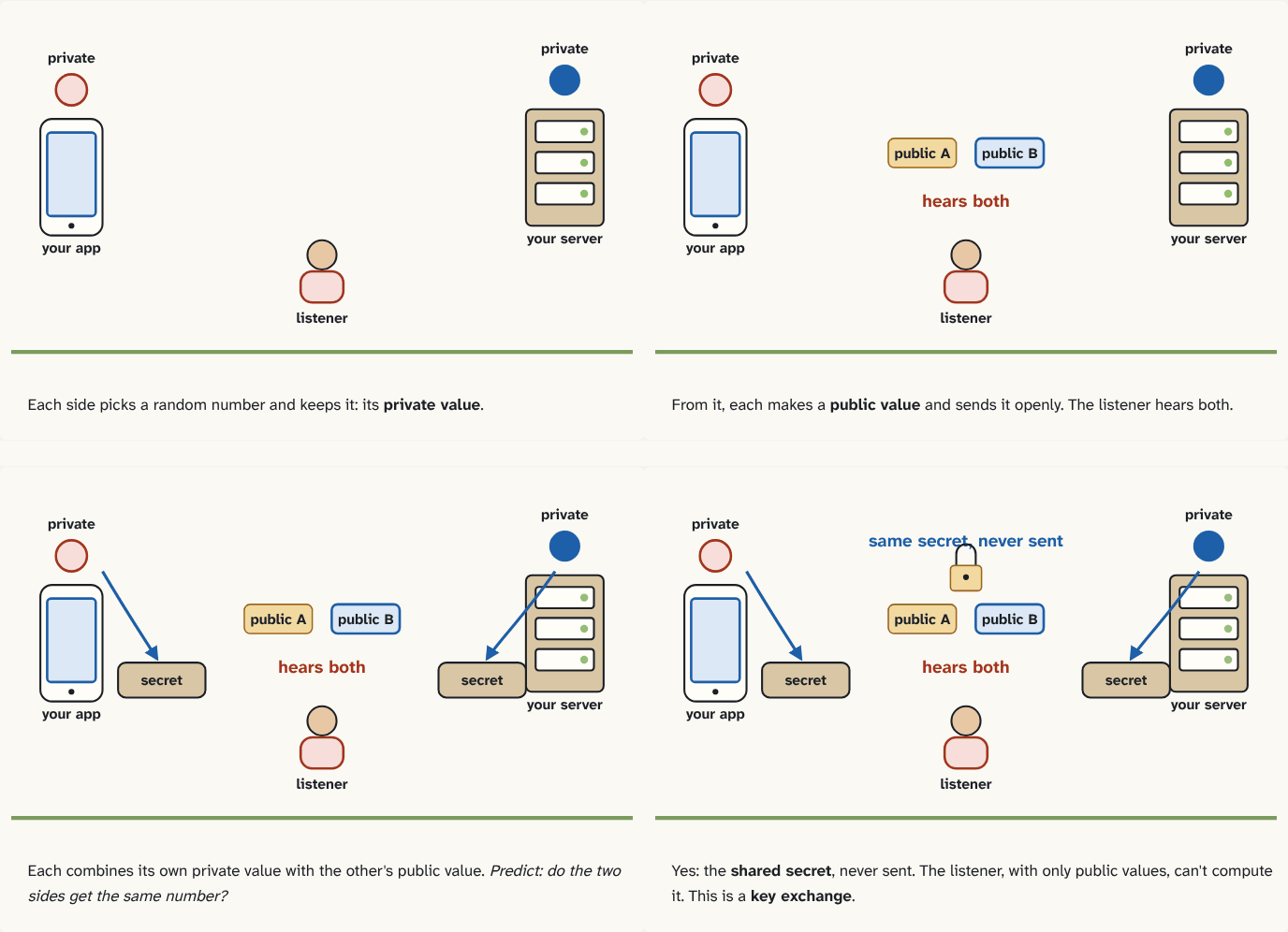
Each side picks a random number and keeps it: its private value.
Step 1 of 4From it, each makes a public value and sends it openly. The listener hears both.
Step 2 of 4Each combines its own private value with the other's public value. Predict: do the two sides get the same number?
Step 3 of 4Yes: the shared secret, never sent. The listener, with only public values, can't compute it. This is a key exchange.
Step 4 of 4
The building block
It is, with a key exchange. The idea, in the form called Diffie–Hellman, which HTTPS uses:
- Each side picks a random number and keeps it to itself: its private value.
- From it, each computes a public value and sends it openly. Going from private to public is easy; going back, from the public value to the private one, is a problem nobody knows how to solve in any useful time.
- Each side combines its own private value with the other side's public value. The math works out so both get the same number: the shared secret.
The listener has both public values, but neither private one, and with only public values there's no known way to compute the shared secret. So both sides now share a secret nobody else has, and the keys for AES from puzzle 1 are derived from it: computed from it in a fixed way both sides follow (puzzle 5). Once the connection ends, both private values are thrown away, so every connection gets fresh ones.
Mixing paint gives the feel of it. Both start from the same yellow, agreed in public. Each mixes a secret color into it and sends the mix. Each then adds its own secret color to the other's mix. Both end with the same brown; the listener, holding only the two mixes, can't un-mix them.
One gap is left: the exchange tells you that you share a secret with whoever answered, not who that is. If the listener answers in your server's place, you've agreed a secret with the listener. Puzzle 4 closes that gap.
The analogy
The paint, above: two people end up with the same color, and someone watching every mix travel between them still can't make it.
Check yourself
Sources
- RFC 8446: TLS 1.3, section 4.2.8 and section 7.4 (the key exchange modes include "(EC)DHE (Diffie-Hellman over either finite fields or elliptic curves)"; section 7.4, "(EC)DHE Shared Secret Calculation")
What you now know
In a key exchange, each side keeps a private value and sends a public value made from it. Each combines its own private value with the other's public value, and both get the same shared secret. The listener sees only the public values and can't compute it. But it doesn't tell you who you agreed with.
Answer every question above correctly to unlock the next puzzle.
Something wrong or unclear on this page? Tell me: a puzzle that didn't click is a bug in the puzzle.