Encryption, from the ground up · Puzzle 1 · 2 of 6
One key for both
In puzzle 0, encryption turned the password into gibberish. Here's how the standard way does it, why it's fast, and the one problem it leaves open.
The problem
In puzzle 0, encryption turned the password into ciphertext with a key. Your app and your server will send thousands of messages: every request, every response, every image. Whatever does the encrypting has to be fast, and both sides have to be able to undo it. What does that look like?
See it
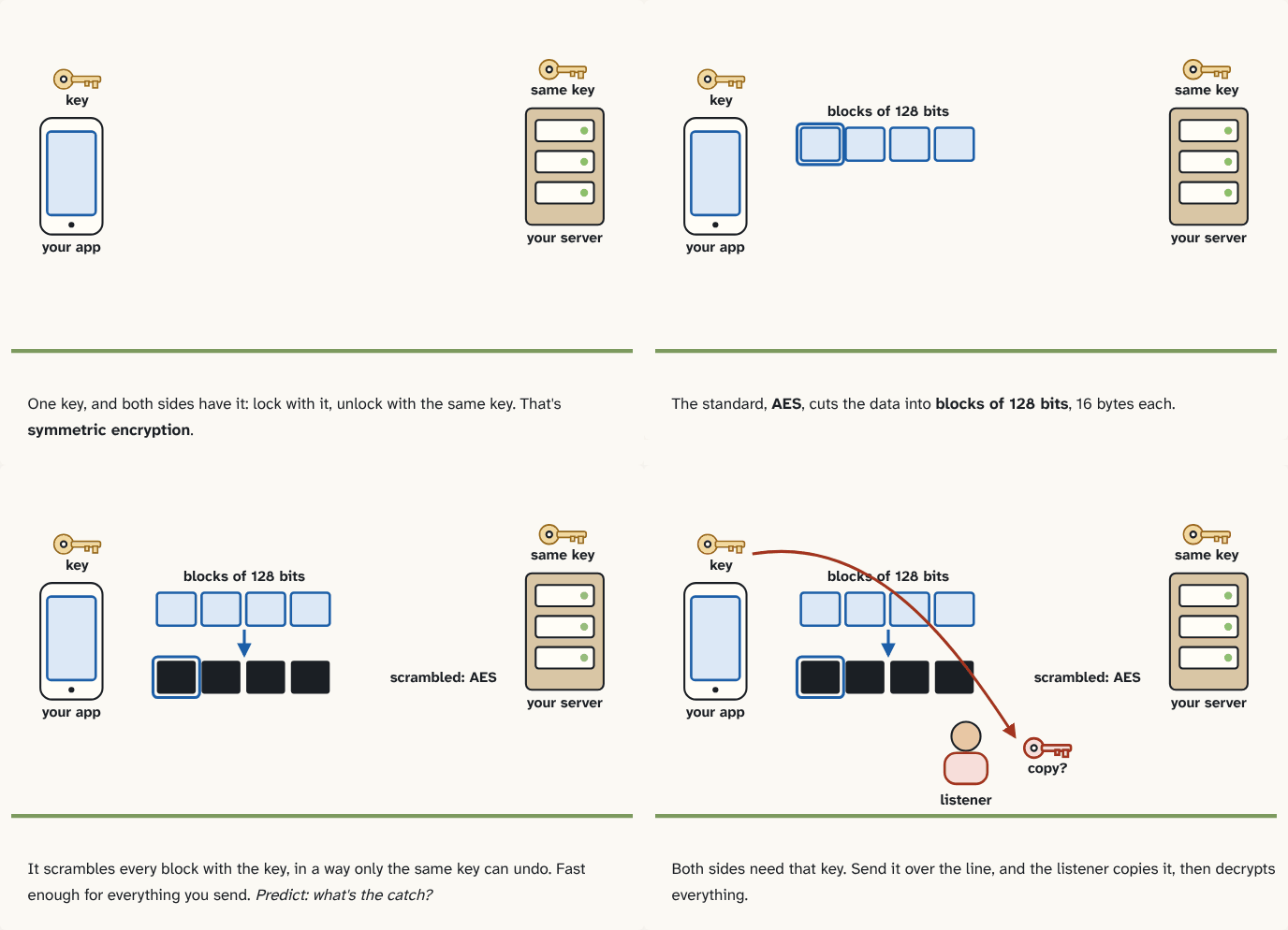
One key, and both sides have it: lock with it, unlock with the same key. That's symmetric encryption.
Step 1 of 4The standard, AES, cuts the data into blocks of 128 bits, 16 bytes each.
Step 2 of 4It scrambles every block with the key, in a way only the same key can undo. Fast enough for everything you send. Predict: what's the catch?
Step 3 of 4Both sides need that key. Send it over the line, and the listener copies it, then decrypts everything.
Step 4 of 4
The building block
The simplest arrangement: one key, and it works both ways. Encrypt with it, decrypt with the same key. That's symmetric encryption.
The standard one is AES. It takes the data in blocks of 128 bits (16 bytes) and scrambles each with the key, in rounds of mixing and substituting, in a way that can only be undone with that same key. Keys come in three sizes: 128, 192 or 256 bits. A 128-bit key has 2 to the power 128 possible values, a 39-digit number: far more than any computer could ever try, which is why guessing it isn't a way in.
AES is fast, and phone chips have circuits built for it, so it can encrypt everything you send. (In real use, AES doesn't scramble your data blocks directly, which would make two identical blocks look identical. Instead it scrambles a counter, a number that goes up by one for every block, and the scrambled result is mixed into your data. Same key, a fresh pattern every block. And puzzle 5 adds a check against changes.) That's why, as puzzle 5 shows, even HTTPS uses it for all the actual data.
But it leaves one problem. Your app and your server both need the same key. You can't send it over the line from puzzle 0: the listener would copy it, and then decrypt everything. And you can't build one key into every copy of your app: anyone could pull it out of the app file. How do two sides get the same key, when everything they say can be heard? That's puzzle 2.
The analogy
A box with one lock and one key, cut twice. Lock it with your copy, your friend opens it with theirs. The box is fast and strong. The hard part is getting the second copy of the key to your friend without anyone on the way copying it.
Check yourself
Sources
- NIST FIPS 197: Advanced Encryption Standard (AES) ("The AES algorithm is a symmetric block cipher that can encrypt (encipher) and decrypt (decipher) digital information. The AES algorithm is capable of using cryptographic keys of 128, 192, and 256 bits to encrypt and decrypt data in blocks of 128 bits.")
What you now know
In symmetric encryption, the same key locks and unlocks. AES, the standard, encrypts in blocks of 128 bits with a key of 128, 192 or 256 bits; it's fast enough for everything you send. Its open problem: both sides need the same key, and you can't just send it.
Answer every question above correctly to unlock the next puzzle.
Something wrong or unclear on this page? Tell me: a puzzle that didn't click is a bug in the puzzle.