Kotlin Multiplatform, from the compiler up · Puzzle 8 · 9 of 10
What Compose actually shares
One set of Compose UI code runs on Android and on iOS. "Same code" hides three layers. Here's which ones are shared, and the one that's written again for every platform.
The problem
You wrote a @Composable screen in commonMain. On Android it shows your list; on an iPhone it shows the same list. But Jetpack Compose was built for Android: it draws through Android's own screen classes and reads Android touch events. So what exactly runs on the iPhone, and which part had to be written again?
See it
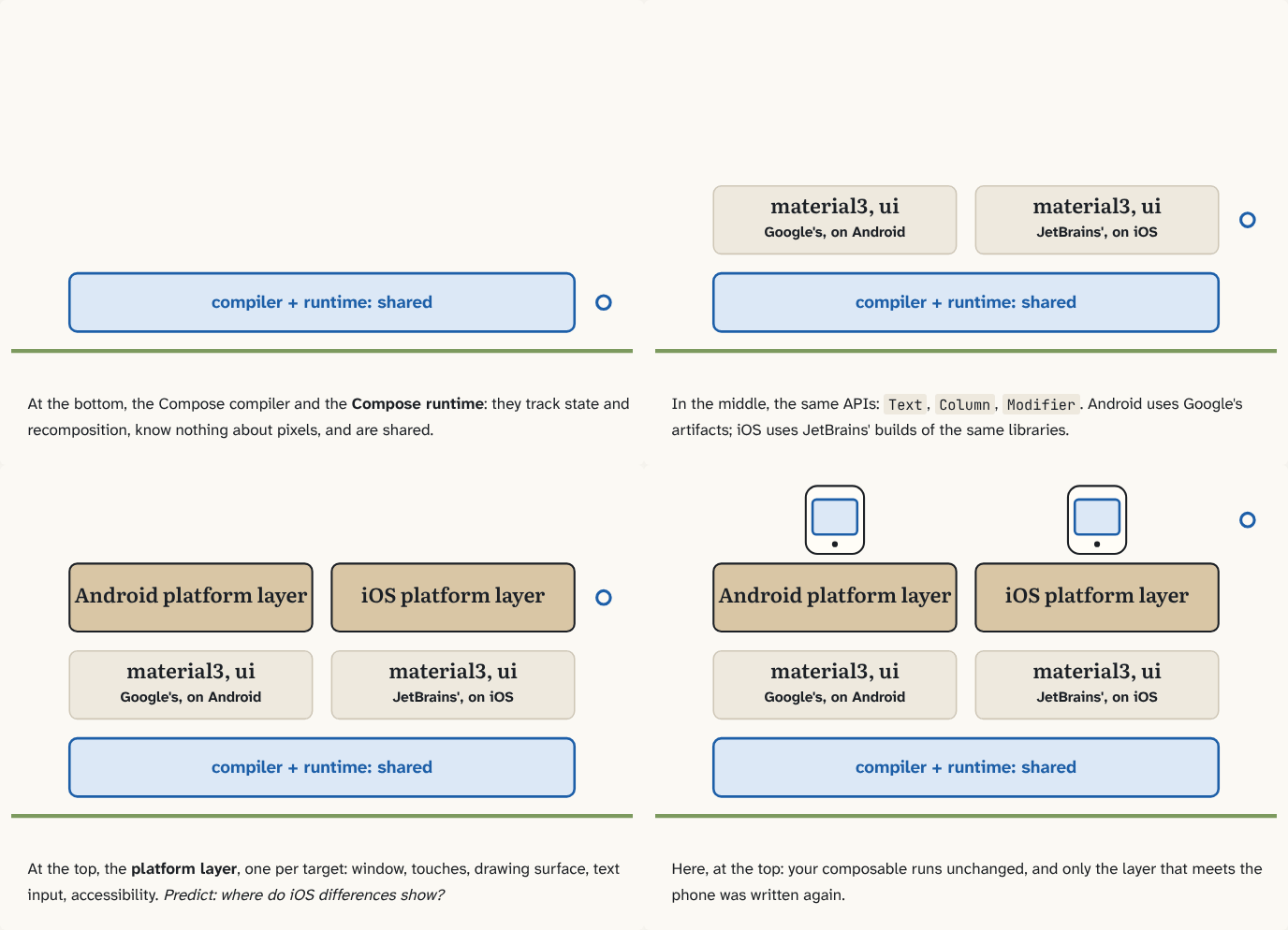
At the bottom, the Compose compiler and the Compose runtime: they track state and recomposition, know nothing about pixels, and are shared.
Step 1 of 4In the middle, the same APIs:
Text,Column,Modifier. Android uses Google's artifacts; iOS uses JetBrains' builds of the same libraries.Step 2 of 4At the top, the platform layer, one per target: window, touches, drawing surface, text input, accessibility. Predict: where do iOS differences show?
Step 3 of 4Here, at the top: your composable runs unchanged, and only the layer that meets the phone was written again.
Step 4 of 4
The building block
Think of Compose as three layers.
At the bottom, the Compose runtime and the Compose compiler plugin. The compiler turns your @Composable functions into code that records what they showed. The runtime tracks state, such as what you remember, and decides what to recompose when it changes. Neither knows anything about pixels or Android, and Compose Multiplatform shares both with Jetpack Compose.
In the middle, the libraries you call: ui, foundation, material3. Text, Column, LazyColumn and Modifier are the same APIs on every target. On Android your build uses Google's Jetpack Compose artifacts. On iOS, desktop and web it uses JetBrains' builds of the same libraries. The Gradle plugin picks for you.
At the top, the platform layer: the part written per target. It's the window your UI lives in, how touches arrive, the surface the UI is drawn onto, the keyboard and text input, and what accessibility tools such as VoiceOver are told. That's the thin part JetBrains rewrote for iOS, and it's where platform differences show.
Some APIs never leave Android: anything that needs a Context, such as LocalContext, or Android resources through R. They stay in androidMain.
The analogy
A play staged in two theatres. The script and the actors (runtime and libraries) travel. Each theatre has its own stage, lights and doors (the platform layer), so the same scene can feel slightly different in each.
Check yourself
Sources
- Kotlin docs: Compose Multiplatform and Jetpack Compose ("It shares the Compose compiler and runtime with Jetpack Compose and uses the same APIs"; "When you build your Compose Multiplatform application for Android, you use the Jetpack Compose artifacts published by Google. For example, if you add compose.material3 to your dependencies, your project will use androidx.compose.material3:material3 in the Android target, and org.jetbrains.compose.material3:material3 in other targets.")
What you now know
Compose Multiplatform shares the Compose compiler and runtime with Jetpack Compose, and the same APIs. On Android your build uses Google's Jetpack Compose artifacts; on iOS, desktop and web it uses JetBrains' builds of the same libraries. What's written per target is the platform layer: window, touches, drawing surface, text input and accessibility.
Answer every question above correctly to unlock the next puzzle.
Something wrong or unclear on this page? Tell me: a puzzle that didn't click is a bug in the puzzle.