Kotlin Multiplatform, from the compiler up · Puzzle 5 · 6 of 10
Two ways to free memory
Your shared Kotlin runs inside an iOS app. Kotlin's objects are freed one way, Swift's another. Here's what happens where they hold on to each other.
The problem
In module 1, your Kotlin compiled to native code inside an iOS app. On Android, the garbage collector frees your objects. Swift frees its objects with ARC, the moment nothing refers to them (the iOS course, puzzle 4). Now a Swift screen holds your Kotlin view model, and the view model keeps a callback that points back at the screen. Who frees what, and when?
See it
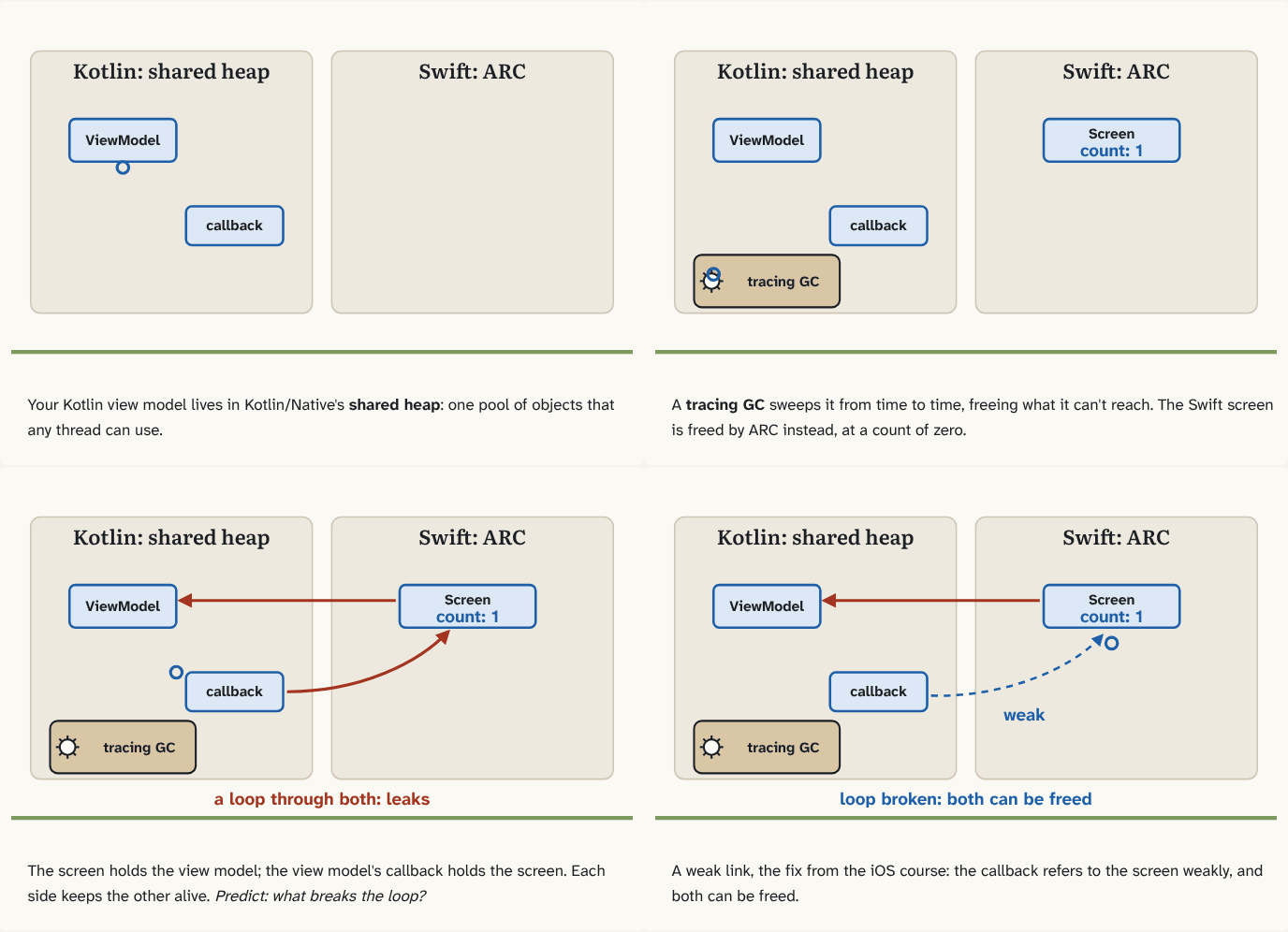
Your Kotlin view model lives in Kotlin/Native's shared heap: one pool of objects that any thread can use.
Step 1 of 4A tracing GC sweeps it from time to time, freeing what it can't reach. The Swift screen is freed by ARC instead, at a count of zero.
Step 2 of 4The screen holds the view model; the view model's callback holds the screen. Each side keeps the other alive. Predict: what breaks the loop?
Step 3 of 4A weak link, the fix from the iOS course: the callback refers to the screen weakly, and both can be freed.
Step 4 of 4
The building block
Kotlin/Native keeps its objects in a shared heap: one pool of objects any thread can use, like on the JVM. From time to time a tracing GC runs: it starts from the roots, such as local and global variables, follows every reference, and frees everything it couldn't reach. That's the garbage collector you know from Android.
Swift objects are freed by ARC: each counts its strong references and is freed when the count hits zero.
Where the two meet, each side follows its own rules:
- A Kotlin object that Swift holds stays alive while Swift holds it: to the GC, Swift's hold counts as a root.
- A Swift object that Kotlin holds isn't freed the moment Kotlin lets go. It's freed at the next GC, when the collector finds Kotlin no longer reaches it. So Swift's
deinitcan run later than a Swift developer expects. - A cycle that runs through both sides, Kotlin to Swift and back, can leak. Each side holds the other, and neither tool sees the whole loop.
The fix is the one from the iOS course: make one link weak. Usually the Swift side holds the Kotlin object normally and the callback refers back to the Swift object weakly: in Swift, capture it with [weak self] in the closure you hand to Kotlin.
The analogy
Two cities that clean their streets differently: one sends a sweeper round every few days (the GC), the other picks up each item the moment its owner lets go (ARC). An item two neighbours from different cities each keep "for the other one" is never picked up by either.
Check yourself
Sources
- Kotlin docs: Kotlin/Native memory management ("Objects are stored in a shared heap and can be accessed from any thread. Tracing garbage collection is performed periodically to collect objects that are not reachable from the 'roots', like local and global variables.")
- Kotlin docs: Integration with Swift/Objective-C ARC ("An object is reclaimed only during the garbage collection. This applies to Swift/Objective-C objects that cross interop boundaries into Kotlin/Native"; "To avoid retain cycles, use weak or unowned references")
What you now know
Kotlin/Native keeps objects in a shared heap and frees them with a tracing GC, like the JVM. Swift frees with ARC. A Swift object held by Kotlin is only freed at a GC, not the moment it's let go; and a cycle that runs through both sides can leak. Break it with a weak reference on the Swift side.
Answer every question above correctly to unlock the next puzzle.
Something wrong or unclear on this page? Tell me: a puzzle that didn't click is a bug in the puzzle.