Kotlin Multiplatform, from the compiler up · Puzzle 1 · 2 of 10
What every target has
In puzzle 0, one Kotlin file became bytecode and native code. But some code only makes sense on one platform. Here's how a project says which code goes where.
The problem
In puzzle 0, one Kotlin file was compiled for Android and for an iPhone. Now your shared code reads a file with java.io.File. On Android, fine: it's part of the Java library the JVM brings. An iPhone has no Java library at all. Which code is allowed to call what, and who decides?
See it
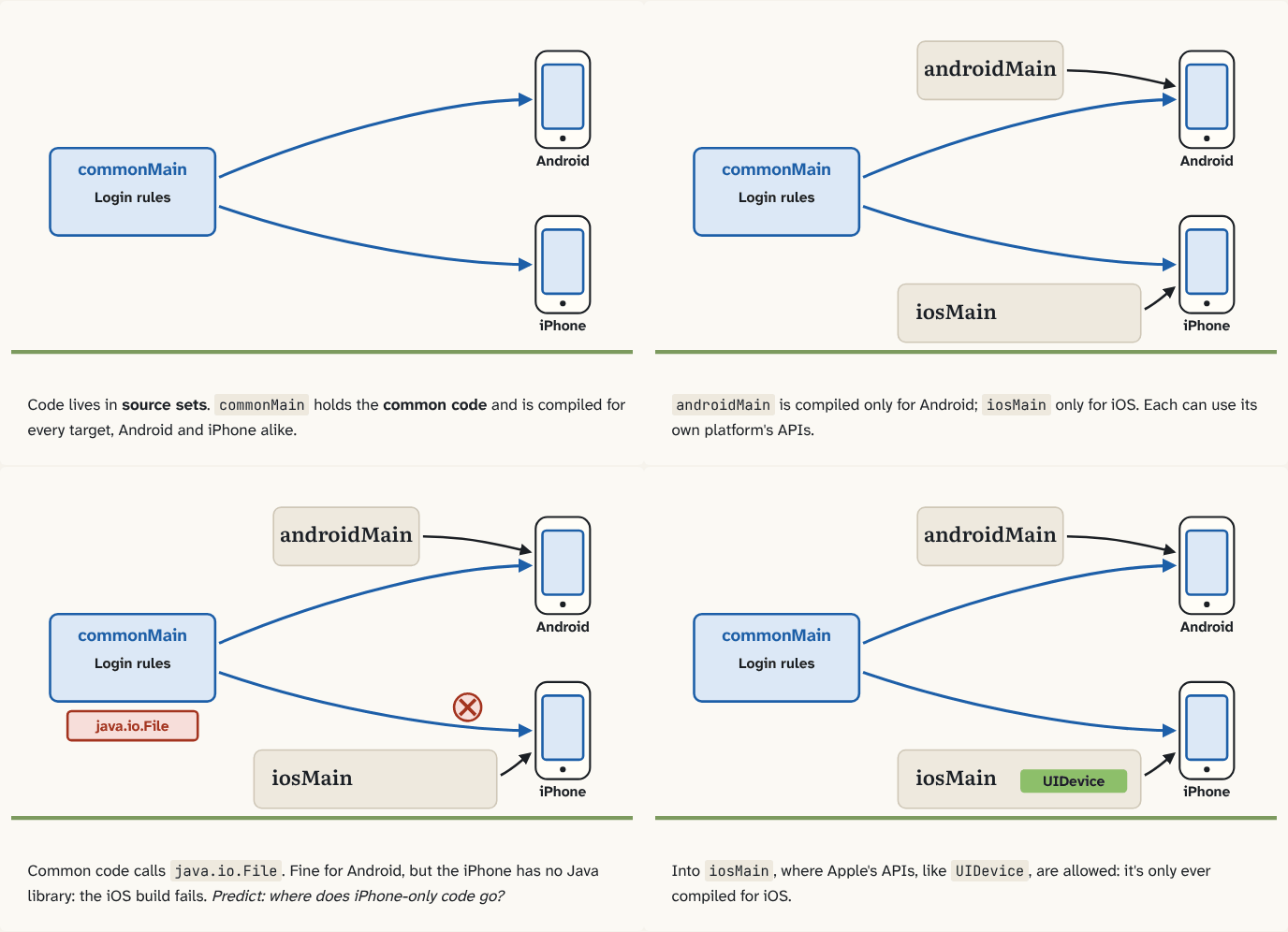
Code lives in source sets.
commonMainholds the common code and is compiled for every target, Android and iPhone alike.Step 1 of 4androidMainis compiled only for Android;iosMainonly for iOS. Each can use its own platform's APIs.Step 2 of 4Common code calls
java.io.File. Fine for Android, but the iPhone has no Java library: the iOS build fails. Predict: where does iPhone-only code go?Step 3 of 4Into
iosMain, where Apple's APIs, likeUIDevice, are allowed: it's only ever compiled for iOS.Step 4 of 4
The building block
A multiplatform project keeps its code in source sets: folders, each compiled for a chosen set of targets.
commonMain is compiled for every target. Its code is the common code, and it may only use what every target has: the Kotlin standard library, and libraries built for every target themselves, like Kotlin's own coroutines library. java.io.File isn't one of them, because the iPhone has no Java library to provide it.
androidMain is compiled only for Android, so it can use anything Android and Java offer. iosMain is compiled only for iOS, so it can use Apple's own APIs, like UIDevice. Common code can't see into either: it doesn't know which platform it will end up on.
In Gradle, you list the targets in the build file, and each source set is a folder under src, like src/commonMain and src/iosMain.
The rule is what makes sharing safe: if something compiles in commonMain, it has something to run on, on every target.
The analogy
A company with offices in two countries. Rules in the shared handbook must make sense in both, so they can't say "call the local tax office by its name". Each office keeps a local folder for what only applies there.
Check yourself
Sources
- Kotlin docs: The basics of Kotlin Multiplatform project structure ("Common code is the Kotlin code shared among different platforms… typically located in the commonMain directory. The location of code files is important, as it affects the list of platforms to which this code is compiled"; "a shared module with the commonMain, iosMain, and androidMain source sets")
What you now know
Code lives in source sets. commonMain is compiled for every target, so it may only use what every target has; androidMain and iosMain are compiled for one platform each and can use that platform's own APIs.
Answer every question above correctly to unlock the next puzzle.
Something wrong or unclear on this page? Tell me: a puzzle that didn't click is a bug in the puzzle.