Bluetooth Low Energy, from the radio up · Puzzle 1 · 2 of 5
Shouting into the room
In puzzle 0, the strap's radio slept almost all the time. Here's how a device that's nearly always asleep still gets found.
The problem
In puzzle 0, the strap's radio slept almost all the time to save its battery. But you open an app, and your phone finds the strap in a second or two. How does a phone find something that's nearly always asleep?
See it
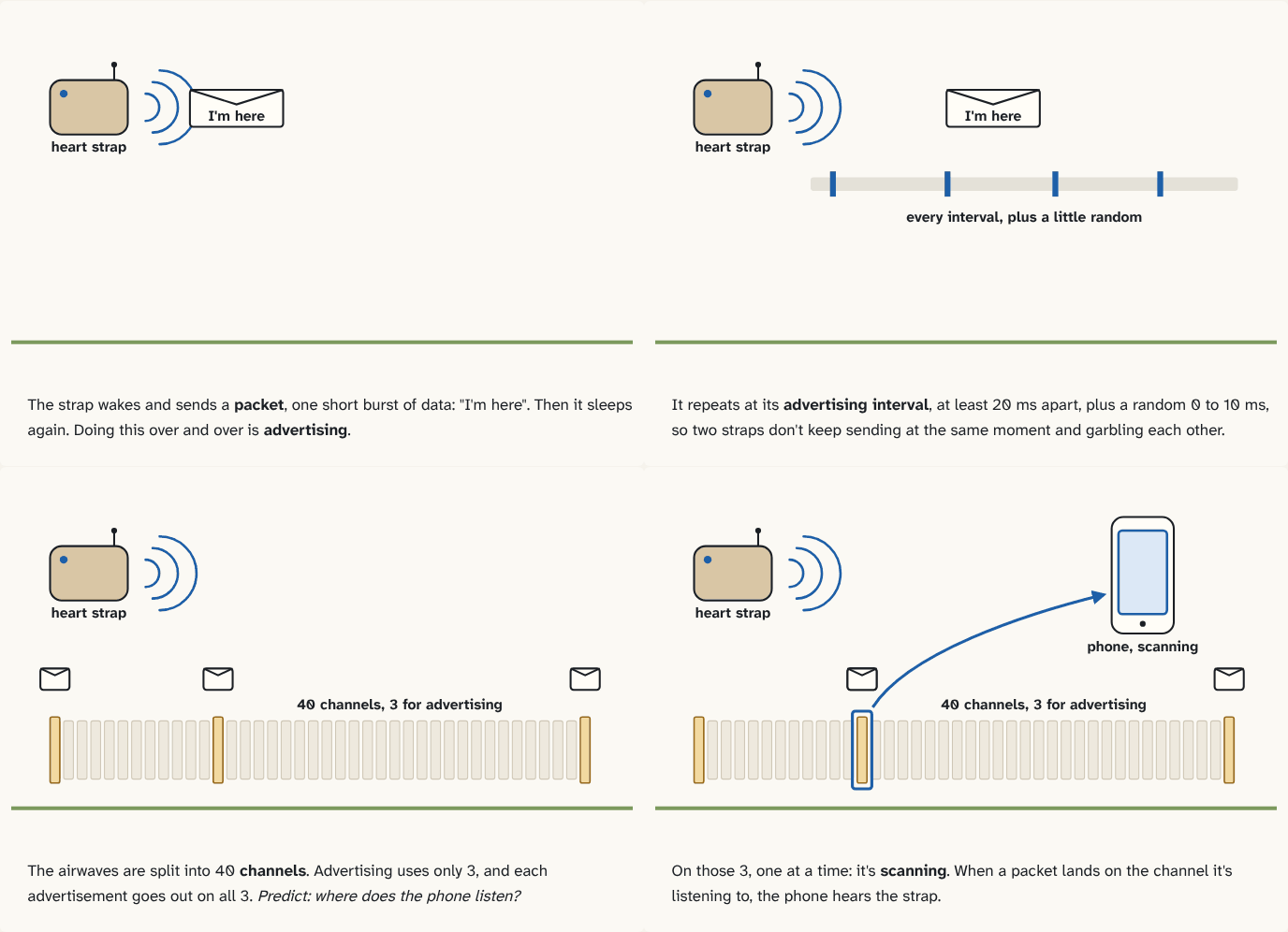
The strap wakes and sends a packet, one short burst of data: "I'm here". Then it sleeps again. Doing this over and over is advertising.
Step 1 of 4It repeats at its advertising interval, at least 20 ms apart, plus a random 0 to 10 ms, so two straps don't keep sending at the same moment and garbling each other.
Step 2 of 4The airwaves are split into 40 channels. Advertising uses only 3, and each advertisement goes out on all 3. Predict: where does the phone listen?
Step 3 of 4On those 3, one at a time: it's scanning. When a packet lands on the channel it's listening to, the phone hears the strap.
Step 4 of 4
The building block
The strap is loud only for moments. It wakes, sends a packet, one short burst of data, that says "I'm a heart strap, here's my name", listens for a moment in case someone answers (puzzle 2 uses that), and goes back to sleep. Doing that over and over is advertising.
The time between two advertisements is the advertising interval: at least 20 ms, and it can be seconds or much longer. Short means found fast; long means a longer battery life. To every interval the radio adds a random delay of 0 to 10 ms. Two packets sent at the same moment on the same channel garble each other: a collision. If two straps happened to start together, the random delays make them drift apart instead of colliding every time.
BLE splits its airwaves into 40 channels, like stations on a radio dial: a radio sends or listens on one at a time. Advertising uses only 3 of them, and each advertisement is sent on all 3, one after another. Three is few enough that a listener knows where to listen, and more than one, so noise on a single channel (another radio, like Wi-Fi, sending on the same slice) doesn't hide the strap.
Your phone, meanwhile, is scanning: listening on the advertising channels. It can't hear all three at once, so it listens on one for a while, then the next. Because the strap repeats every interval on all three, sooner or later one of its packets lands on the channel the phone is listening to, and the phone hears it.
The analogy
The lighthouse from puzzle 0 flashes its lamp in three directions, one after another, anything from many times a second to every few seconds. A ship's lookout watches one direction at a time. Sooner or later, a flash lands where the lookout is looking.
Check yourself
Sources
- Bluetooth Core Specification 5.4, Vol 6, Part B: Link Layer ("40 RF channels are defined… divided into 3 RF channels known as the 'primary advertising channels'… and 37 RF channels known as the 'general-purpose channels'"; "The advertising interval (advInterval) shall be an integer multiple of 0.625 ms in the range 20 ms to 10,485.759375 s. The advDelay is a (pseudo-)random value with a range 0 ms to 10 ms"; "When scanning, the Link Layer shall listen on the primary advertising physical channel")
What you now know
A device advertises: it wakes, sends a short packet on each of the 3 advertising channels, and sleeps, over and over at its advertising interval. A phone scans: it listens on those channels until one packet lands while it's listening.
Answer every question above correctly to unlock the next puzzle.
Something wrong or unclear on this page? Tell me: a puzzle that didn't click is a bug in the puzzle.