Bluetooth Low Energy, from the radio up · Start here · 1 of 5
A year on a coin battery
A heart-rate strap runs for months on a battery the size of a coin. Here's the one idea that makes that possible, and that every later puzzle follows from.
The problem
Your Bluetooth headphones need charging every day or two. A heart-rate strap, a key finder or a plant sensor runs for months on a battery the size of a coin. Both talk over Bluetooth. What do the small devices do differently?
See it
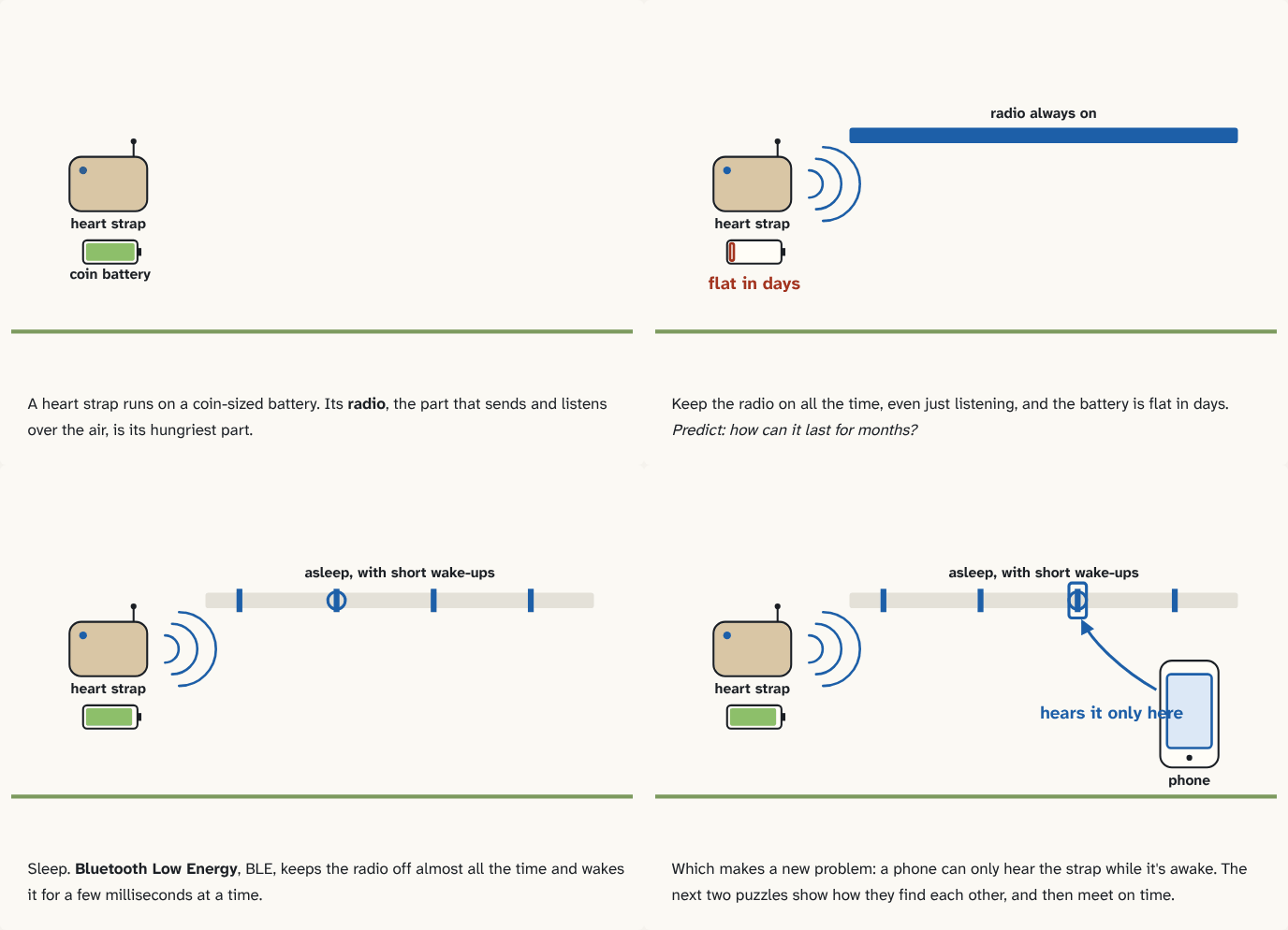
A heart strap runs on a coin-sized battery. Its radio, the part that sends and listens over the air, is its hungriest part.
Step 1 of 4Keep the radio on all the time, even just listening, and the battery is flat in days. Predict: how can it last for months?
Step 2 of 4Sleep. Bluetooth Low Energy, BLE, keeps the radio off almost all the time and wakes it for a few milliseconds at a time.
Step 3 of 4Which makes a new problem: a phone can only hear the strap while it's awake. The next two puzzles show how they find each other, and then meet on time.
Step 4 of 4
The building block
A device's radio is the part that sends and listens over the air. A radio that is on, sending or just listening, uses far more power than the rest of the device asleep. For a small device, it's the hungriest part.
Bluetooth Low Energy, BLE for short, is the kind of Bluetooth built for tiny batteries. Its trick is simple to say: keep the radio off almost all the time. The device sleeps, wakes for a few milliseconds to send or listen, and goes back to sleep for much longer than it was awake: anything from a few milliseconds (ms) to seconds. Your headphones use the original Bluetooth, which keeps the radio busy streaming sound; that's why they need charging every day or two.
That creates the two problems the next puzzles solve. A device that's asleep almost all the time is hard to find: how does your phone ever hear it? (puzzle 1) And once they've found each other, how do two devices that both sleep meet at the same moment? (puzzle 2)
The analogy
A lighthouse keeper on a tiny budget. Leaving the lamp on all night empties the fuel tank. So the keeper flashes it for a split second, then waits, then flashes again. Ships learn to watch for the flashes.
Check yourself
Sources
- Bluetooth Core Specification 5.4, Vol 6, Part B: Link Layer (devices meet at planned moments: "A connection event is a point of synchronization between the Central and the Peripheral")
What you now know
The radio is the hungriest part of a small device. BLE keeps it off almost all the time and wakes it only for short, planned moments. Every rule in this course follows from that.
Answer every question above correctly to unlock the next puzzle.
Something wrong or unclear on this page? Tell me: a puzzle that didn't click is a bug in the puzzle.