Android from the foundation · Puzzle 4 of 6
system_server is the town hall
One long-running process holds Android's system services. It keeps the register of every app's screens and decides their lifecycle, not your app.
The problem
In puzzle 3, Zygote also started system_server. Why does Android need it? If every app is locked in its own house, someone has to decide which app is on screen, which app opens a link, and which screens exist. It has to be one trusted place that sees all the houses.
See it
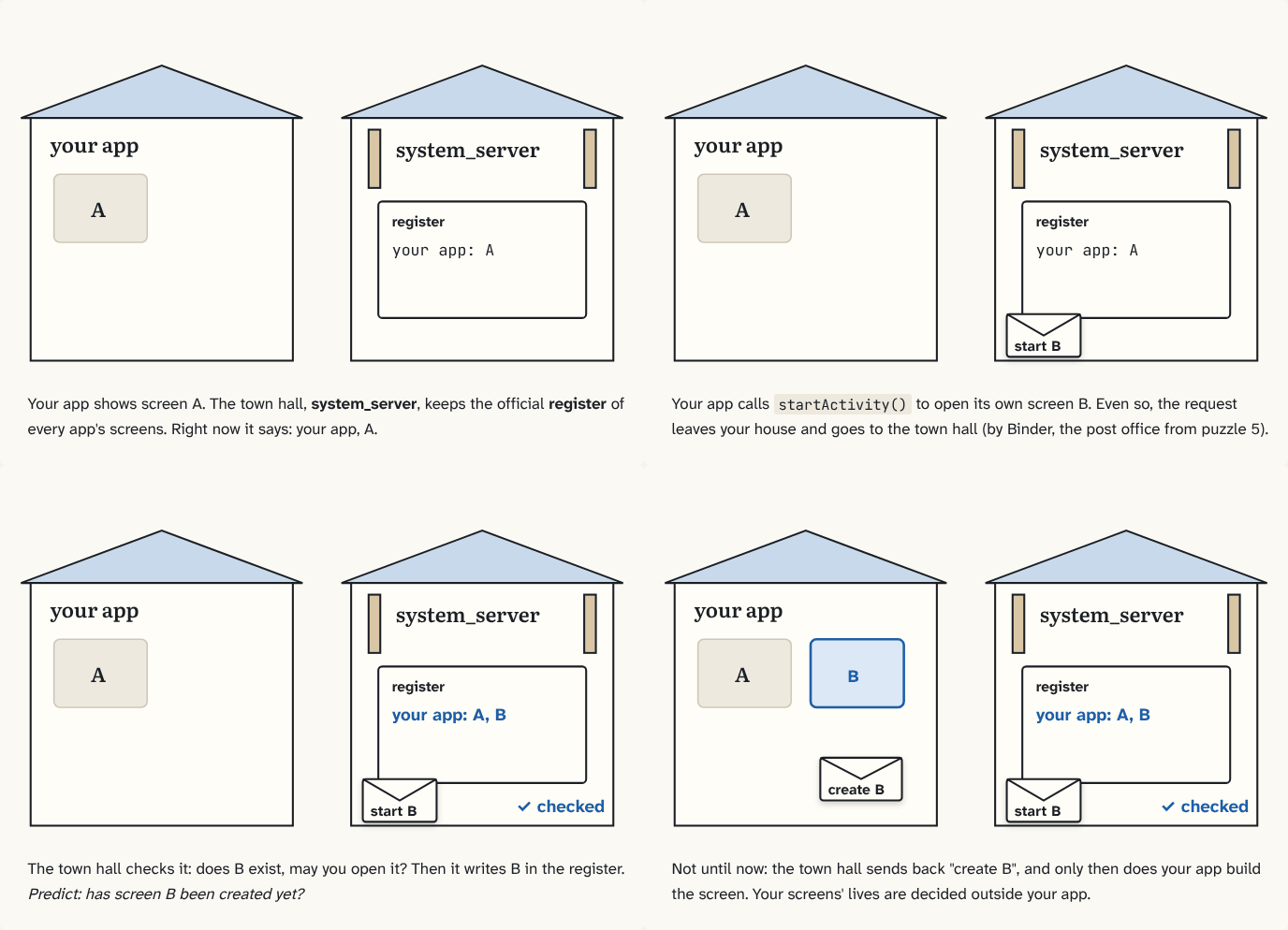
Your app shows screen A. The town hall, system_server, keeps the official register of every app's screens. Right now it says: your app, A.
Step 1 of 4Your app calls
startActivity()to open its own screen B. Even so, the request leaves your house and goes to the town hall (by Binder, the post office from puzzle 5).Step 2 of 4The town hall checks it: does B exist, may you open it? Then it writes B in the register. Predict: has screen B been created yet?
Step 3 of 4Not until now: the town hall sends back "create B", and only then does your app build the screen. Your screens' lives are decided outside your app.
Step 4 of 4
The building block
system_server starts at boot and runs as long as the phone is on. Inside it live the system services. The one that manages screens is ActivityTaskManagerService: it keeps a record of every Activity of every app, and tells each app when to create, pause, stop or destroy one. Other services handle installed apps, windows, notifications and more.
It starts in SystemServer.main()system_server's entry point: it starts the bootstrap services (activities, packages, power…). 684 public static void main(String[] args) {
685 new SystemServer().run();
…
976 startBootstrapServices(t);SystemServer.java, line 684 · AOSP frameworks/base ↗. When your app calls startActivity(), the request arrives in ActivityTaskManagerService.startActivity()Where your startActivity() lands inside system_server, after crossing Binder. 1226 public final int startActivity(IApplicationThread caller, String callingPackage,
…
1230 return startActivityAsUser(caller, callingPackage, callingFeatureId, intent, resolvedType,ActivityTaskManagerService.java, line 1226 · AOSP frameworks/base ↗.
The analogy
The town hall keeps the official register of every house and every room. You don't add a room on your own; you send a request, and they send you the decision.
Check yourself
Sources
What you now know
startActivity(), even for your own screen, is a letter to the town hall. It checks, writes the screen in its register, and only then tells your app to create it.
Answer every question above correctly to unlock the next puzzle.