Android from the foundation · Puzzle 1 of 6
An app is a Linux process with its own user
Each app gets its own Linux user ID and its own process. The kernel keeps them apart, so one app can't open another's files or read its memory.
The problem
In puzzle 0, your app was a house. But a phone has dozens of houses from different companies, and a banking app must be safe from a game that wants to read its files or its memory. How do you keep them apart without trusting either of them?
See it
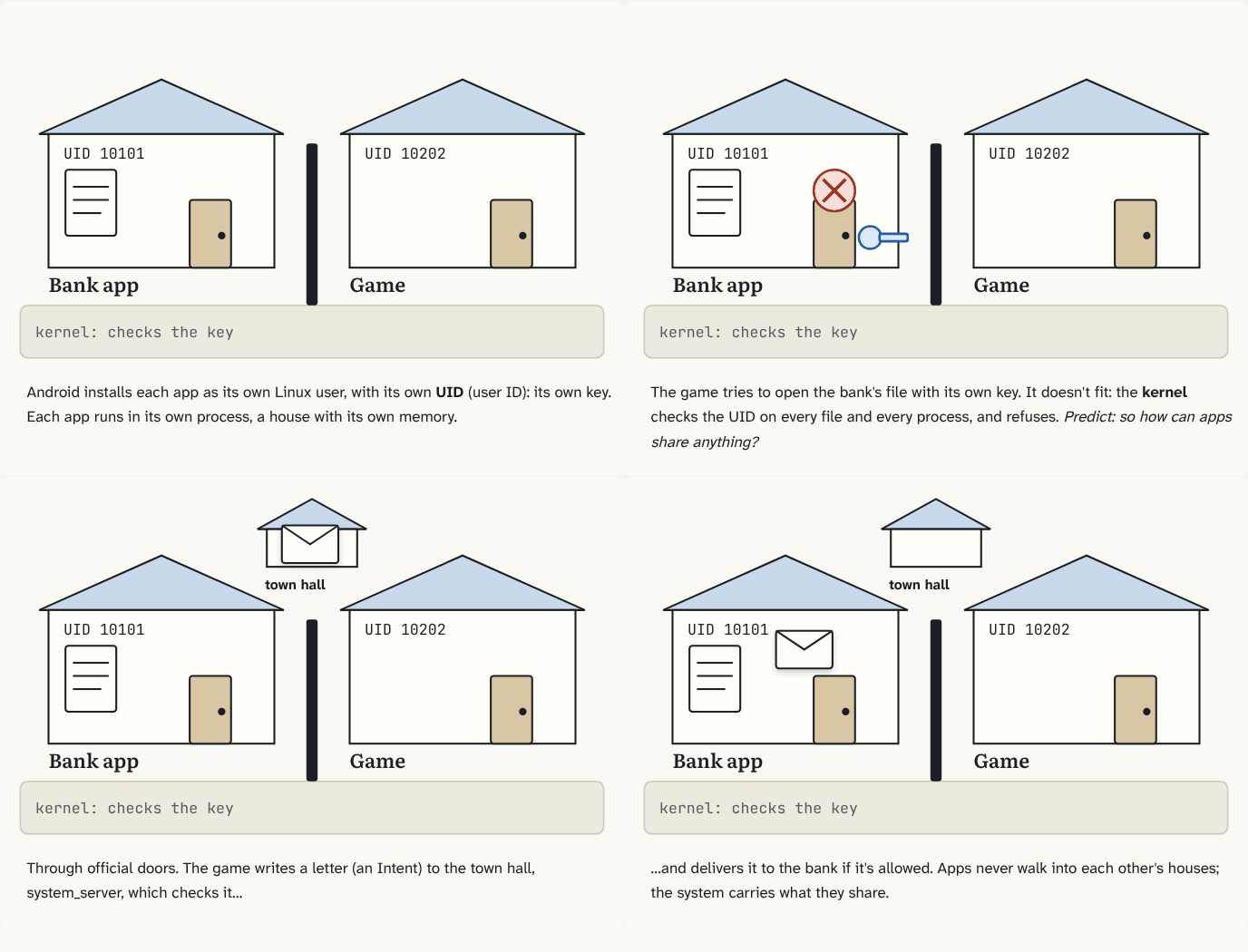
Android installs each app as its own Linux user, with its own UID (user ID): its own key. Each app runs in its own process, a house with its own memory.
Step 1 of 4The game tries to open the bank's file with its own key. It doesn't fit: the kernel checks the UID on every file and every process, and refuses. Predict: so how can apps share anything?
Step 2 of 4Through official doors. The game writes a letter (an Intent) to the town hall, system_server, which checks it…
Step 3 of 4…and delivers it to the bank if it's allowed. Apps never walk into each other's houses; the system carries what they share.
Step 4 of 4
The building block
Android is built on Linux, and Linux already knows how to keep users apart. So Android turns each app into its own user: at install time the app gets a unique user ID (UID), and it runs in its own process.
- Files the app creates belong to its UID; other apps can't open them.
- A process can't read another process's memory.
- The kernel enforces both, so a buggy or hostile app can't switch them off.
You'll see the same UID written two ways: 10101 is the number, u0_a101 is its name in tools like ps. The kernel guards files and memory; in puzzle 5 you'll see how system_server guards everything else, using the same UID.
The analogy
Every app is a house with its own key. The kernel is the lock on every door: it only opens for the right key. Neighbours who want something send a letter through the town hall.
Check yourself
Sources
What you now know
Your app is a house with its own key (a UID) and its own walls (a process). The kernel checks the key on every file. To get anything from another app, you send a letter through the town hall.
Answer every question above correctly to unlock the next puzzle.